
About the Interdisciplinary Space Asiancy
The Interdisciplinary Space Asiancy project takes up the historical, literary, spatial and community-oriented aspects of Asian Canadian Studies to query what the field can be in the present moment, both inside and outside the university. While, as Donald Goellnicht has argued, Asian Canadian Studies has been slow to consolidate as a discipline in the academy, though one might argue that it has a longstanding history outside the academy, in Asian Canadian communities, through the cultural and political production of entities like the Asian Canadian Writers' Workshop, Rungh Magazine, Desh Pardesh, Yellow Peril: Reconsidered, Chinese Canadian Cultural Productions, the National Association of Japanese Canadians, Chinese Canadian National Council, the Chinatown Land Trust, and many more. But now that it has made its entry into the academy, how can we understand its relationship to the traditional disciplines, and more specifically to Asian Canadian scholarship done in disciplinary contexts. How can all of these contexts be brought into conversation with one another?
Further, what kind of container is the nation now? If both state and race nationalisms are sometimes useful yet often dangerous, and always limited in scope, and if they run the risk of overdetermining the subject, how else might Asianness be spatialized or otherwise formed? Further what can the relationship be between Asian Canadian Studies and Asian American Studies? What can the relationship be between Asian Canadian Studies and Asian Studies? How is the space of Asian Canada related to the Asian Pacific? Further still, what ought our relationships be to Blackness and Indigeneity, and specifically to questions of land, property and sovereignty? Even within its own framing, "Asian" has historically meant different things-- sometimes Chinese and Japanese, sometimes East Asian, sometimes South Asian, sometimes pan-Asian, sometimes "minor" Asian. Without forgetting its history, how might it be most usefully deployed in the present?
The Interdisciplinary Space Asiancy also takes a cue from the late Roy Miki, who was interested in the possibilities of Asian Canadian subjectivity without overdetermining how such a subject might speak, write or act. Born in internment, and thus rooted in his own experience of dispossession, Miki understands the necessity of grappling with history, both one's own and all that one inherits, including state histories and histories of relation with others. In the essay "Asiancy: Making Space for Asian Canadian Writing," he is specifically interested in what it is that might constitute an Asian Canadian consciousness, and the relationship of consciousness to language, especially, for Miki, poetic language. Silence, or non-language, also still matters. Quoting the feminist Quebecoise poet Gail Scott, he asks: "What if the surfacing consciousness finds void instead of code?"
With care and concern for the coming generations, the project is also interested in the future. It intentionally gestures to speculative fiction, detective fiction and other genre fiction. Considering the work of Hiromi Goto, Saleema Nawaaz, Premee Mohamed, Lydia Kwa, Yilin Wang and many others, the Interdisciplinary Space Agency recognizes the productivity of the imagination for thinking about where we might go and how we might form next.
Directed by Dr. Larissa Lai, the current Richard Charles Lee Chair in Chinese Canadian Studies, based at University College at the University Toronto, the Interdisciplinary Space Asiancy serves to enable critical and creative discussion and production through an ongoing series of events and podcasts.
For more about the Richard Charles Lee Chair in Chinese Canadian Studies, please visit: uc.utoronto.ca/canadian-studies/rcl-chair
Director
Bio
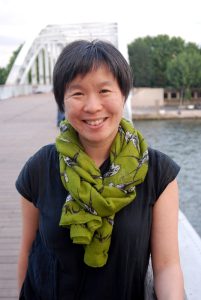
Dr. Larissa Lai is the Richard Charles Lee Chair in Chinese Canadian Studies at University College, University of Toronto. She holds a graduate appointment in the English Department at the same university. She is the author Slanting I, Imagining We: Asian Canadian Literary Production in the 1980s and 1990s, which was a finalist for the ACQL Gabrielle Roy Prize for Literary Criticism. Her most recent novel, The Lost Century, tells the story of two sisters who survive the Japanese occupation of Hong Kong during World War II. Her novel The Tiger Flu, about a heartbroken clone seeking an organ-donor to keep her community alive as the world begins to collapse won a Lambda Literary Award for Lesbian Fiction, as well as a Governor General's Award for its French translation, Les Soeurs de la Muée. It was a Tiptree Honor Book, and a finalist for the Grand Prix de L'Imaginaire as well as a City of Calgary W.O. Mitchell Prize. Her novel Salt Fish Girl, about a very stinky fruit and the snake goddess who made the world was a Tiptree Honor Book, and was shortlisted for the Sunburst Award, the City of Calgary W.O. Mitchell Prize and a Governor General's Award for its French translation Le Fruit de la Puanteur. Her novel When Fox Is a Thousand, about a fox spirit who haunts a twenty-something Chinese Canadian woman coming of age in 1990s Vancouver won an Astraea Foundation Emerging Writers' Award and was shortlisted for the Books in Canada First Novel Award. She has written three books of poetry, Iron Goddess of Mercy, Automaton Biographies (shortlisted for the Dorothy Livesay Poetry Prize), and (with Rita Wong) Sybil Unrest. She is also the recipient of the Jim Duggins Outstanding Mid-Career Novelist Prize. Before coming to the University of Toronto, she held a Canada Research Chair II in Creative Writing at the University of Calgary where she directed The Insurgent Architects' House for Creative Writing which ran numerous symposia, panels and readings and published over fifty podcast interviews with Canadian writers. Both critical and creative collaboration are important aspects of her practice.